





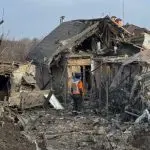
(LONDON) — Russia’s offensive campaign in eastern and southern Ukraine has been grinding on throughout 2025, with much of the fighting of the last 12 months focused on devastated cities in the eastern Donetsk and northeastern Kharkiv regions.
But in September, Russian forces began a relatively rapid advance in the farmlands to the east of Zaporizhzhia, advancing up to six miles in places — according to Ukrainian military officials — as territorial defense units that had been holding the area for two years crumbled under sudden and intense offensive pressure applied by Moscow’s forces.
Russia’s unexpected breakthrough in Zaporizhzhia represented a rare instance of battlefield mobility in a war that has become characterized by labored attritional warfare, in which mechanized troop concentrations and supporting armored vehicles quickly become easy prey for the flocks of drones incessantly swarming above the front lines.
Among the Ukrainian units deployed to stem the Russian advance was the 225th Separate Assault Regiment, which had previously been fighting to repel Russian forces along the shared border in the northeastern Sumy Oblast.
“The situation there remains complicated, and we are trying to stabilize it,” Maj. Oleh Shyriaiev of the 225th regiment told ABC News by phone from close to the front. “It is a mistake to consider that it is 100% stabilized,” he added.
Representatives of the combatants are currently engaged in U.S.-sponsored shuttle diplomacy that the White House hopes will secure an end to Europe’s largest conflict since World War II and a war that U.S. President Donald Trump vowed to end within 24 hours of his return to the Oval Office.
Russian officials have repeatedly framed their slow battlefield gains as evidence of Moscow’s “inevitable” victory, in the words of Deputy Foreign Minister Sergey Ryabkov during a recent interview with ABC News.
That interpretation is hotly disputed by Kyiv and its European allies, but the Kremlin nonetheless seeks to use its gradual seizure of new territory as leverage in the ongoing talks. “The space for freedom of decision-making narrows as territories are lost,” Kremlin spokesperson Dmitry Peskov said in November.
In foxholes, trenches and treelines along the contact line, Shyriaiev said his unit is focused on their day-to-day survival.
“I personally am skeptical about any kind of peace negotiations,” he said. “Even if some kind of a peace agreement is signed, Russia will not stop existing, and it will not stop being our enemy.”
Any deal, he suggested, “will just give time for Russia to regroup. And what happens next? We need to expect a new attack. No guarantees that Russia can give can be considered true guarantees.”
The focus of the Russian offensive in Zaporizhzhia is now in the area of Huliaipole, a small city which before the war was home to around 20,000 people. Only around 150 civilians remain in the devastated city, the head of its military administration told Ukrainian media earlier this month.
In the fields around the city, Ukrainian officials say they have largely stalled Russia’s forward momentum. Shyriaiev said his unit needed time to adapt to the new battlefield and wear down the attackers.
“We had to go out and create a blocking line, fulfil missions and create favorable conditions for further success,” he explained. “At the moment, everything we are doing is focused on stabilizing the front line and blocking the enemy.”
Ukrainian forces in the area are facing Russian units replenished with new recruits and new equipment, Shyriaiev said.
“The enemy has strengthened its UAV component and thanks to that, they are holding under control the access areas to the line of contact — or at least they are trying to hold it under control,” he said.
“The enemy has had some success because their units have been reconstituted according to the most cutting edge experience that they have,” Shyriaiev said. “They have been trained with the latest updates, they have all the ‘lessons learned’” by their predecessors, he added.
Those newly arrived troops are trying to use the wintry weather and resulting “dense fog” to their advantage, Shyriaiev said.
“When there are normal visibility conditions, we can see everything and control everything,” he said. “However, when there is fog around, the enemy is trying to take advantage of this and to infiltrate the space between our positions.”
For the Ukrainians, too, the weather offers opportunities, Shyriaiev said. “When visibility is good, it means that badly hidden or badly masked positions are an open target and the troops that are deployed there can be wounded or destroyed.”
Moscow’s ‘glacial’ advance
Russian President Vladimir Putin has given little indication that he intends to ease the frontline pressure on Kyiv’s troops, despite the recent fresh impetus given to U.S.-brokered peace negotiations.
At his annual end-of-year press conference on Friday, Putin said peace was only possible on the basis of “principles” he outlined in a speech last year, in which he made some of his most hardline demands — Ukraine’s permanent exclusion from NATO and Kyiv’s withdrawal from all of the territory Russia claims in eastern and southeastern Ukraine.
Putin again claimed that military momentum was with Moscow’s forces, saying its troops were “advancing on all fronts.”
Putin’s bombast does not align with battlefield realities, according to Ukrainian officials and independent analysts.
The U.S.-based Institute for the Study of War think tank said this month that Russian forces have seized 0.77% of Ukraine’s territory — some 1,802 square miles — over the past year, while sustaining disproportionately high casualties. The area captured is roughly equivalent to that of Anchorage, Alaska.
Ukraine’s military estimates that Russia has sustained around 1.2 million casualties since February 2022. President Volodymyr Zelenskyy said this month that around 30,000 Russian troops are being killed each month.
Russia does not release details about its casualties, making it difficult to independently confirm that figure. Ukrainian estimates of Russian casualties have broadly chimed with estimates from U.S. and European intelligence agencies since 2022.
Ukraine likewise does not regularly disclose its casualty figures. Zelenskyy said in February 2025 that more than 46,000 Ukrainians have been killed and 380,000 wounded since 2022.
Peter Dickinson, the editor of the Atlantic Council think tank’s UkraineAlert service, wrote in December that while Moscow’s troops hold “the overall initiative,” its attacking units are “grinding forward at glacial pace while suffering catastrophic losses.”
Also this month, Zelenskyy visited the Kharkiv frontline city of Kupyansk, posting videos of himself in the center of the city as proof that Russia’s recent claim to have captured it was false. The visit, Dickinson said, “underscored the fact that Russian victory is anything but inevitable.”
But Putin appears committed to a relentless push, regardless of its slow pace and high cost. Ukrainian Commander-in-Chief Gen. Oleksandr Syrskyi said in a post to Facebook last week that Russia has amassed 710,000 troops along the front for its offensive operations.
“Despite the substantial losses, the Russian army is not giving up on continuing offensive operations, although it has not achieved significant operational success,” Syrskyi said.
Shyriaiev said that although his unit is “well-staffed” and motivated, the difference in manpower and resources is obvious at the front. The Russians, he said, “are focusing on mass in everything.”
Shyriaiev’s unit faces “massive amounts of infantry” attacking from “early morning and until late at night,” he said. “They conduct mechanized assaults on all kinds of vehicles — regular cars, motorbikes, buggies. It could also be proper military equipment, proper military armored vehicles.”
“They are leaving no stone unturned,” he continued. “The ratio of the size of our army and our resources and their resources is, of course, something unfavorable towards us. They have more resources. This is why they do achieve some successes, but that happens at a very high price.”
Copyright © 2025, ABC Audio. All rights reserved.